
By the end of this decade, Maryland could face rolling blackouts, soaring electric bills, and a power grid under severe strain—not because of a natural disaster, but because demand is rising faster than our ability to generate electricity.
This is not speculation. It is the direct result of policy decisions, rapid electrification, and explosive growth in energy-hungry data centers, all colliding with an aging grid and shrinking in-state power supply. If we do not act decisively now, working families, seniors, and small businesses will bear the cost.
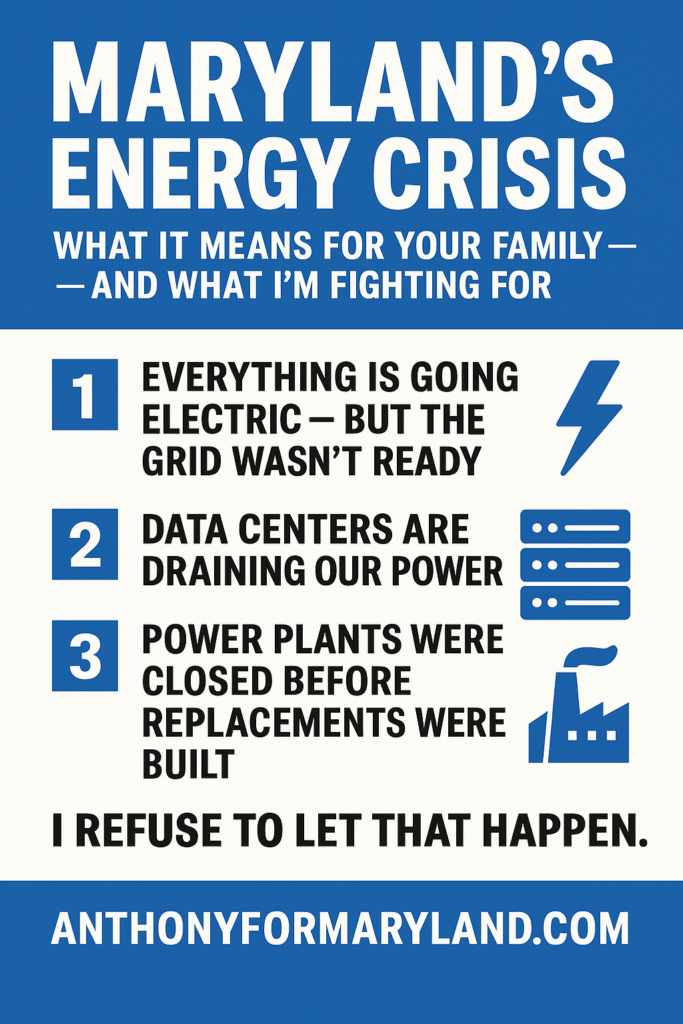
Maryland is electrifying nearly everything—vehicles, home heating, appliances, and major commercial systems. At the same time, data centers powering artificial intelligence, cloud storage, government systems, and streaming services are multiplying across the region. A single data center can use as much electricity as an entire town—24 hours a day, seven days a week. Yet there is currently no data center in the United States powered solely by solar energy. Their massive and constant demand requires firm, always-available power.
Meanwhile, Maryland has shut down several fossil-fuel power plants in pursuit of long-term climate goals. While the transition to clean energy is essential, we failed to replace that lost capacity fast enough with new generation, large-scale battery storage, and grid modernization. The result is a growing supply-demand imbalance that is already pushing prices higher.
Our regional electric grid is managed by PJM, which coordinates power flow across 13 states. PJM has issued repeated warnings: without new generation coming online, grid reliability will be at serious risk by 2027. That means Maryland is now on a dangerous timeline—one measured in months, not decades.
Compounding the risk is a hard truth most residents don’t realize: Maryland only generates about 60% of the electricity it uses. We import the remaining 40% from other states. That makes us vulnerable to regional shortages, price spikes, and emergency disruptions during extreme heat and winter storms. When neighboring states scramble for power, Maryland ratepayers end up paying more.
And they already are.
Utility bills are rising sharply—not just because of the price of electricity, but because roughly half of every bill goes toward delivery costs for poles, wires, substations, and maintenance. Those delivery rates are approved by the Maryland Public Service Commission, and customers have seen steady increases with little visible improvement in reliability.
For residents served by Pepco, the story is especially frustrating: higher bills, continued outages, slow storm recovery, and no clear sense that the system is becoming more resilient. People are paying more without feeling more secure.
If nothing changes, the consequences will be real and personal. Blackouts during heat waves will endanger seniors and medically vulnerable residents. Small businesses will face rising operating costs and lost revenue. Families already struggling with housing and food costs will be forced to choose between keeping the lights on and meeting other basic needs. This becomes not just an energy issue, but a public-health, economic-stability, and equity issue.
Renewable energy must remain central to Maryland’s future—but solar and wind alone cannot yet carry the full load of a modern, data-driven economy. We must aggressively invest in battery storage, diversified clean generation, grid-scale infrastructure, and responsible siting of both power facilities and data centers. Communities must have a real voice in where this infrastructure goes and how it impacts their neighborhoods.
This moment demands balance, urgency, and honesty. We can fight climate change and still protect grid stability. We can grow the tech economy and still shield residents from crushing utility costs. But that requires leadership willing to confront hard trade-offs instead of pretending the system will fix itself.
The electricity powering our phones, our schools, our hospitals, and our businesses is not abstract. It is the foundation of modern life. If Maryland fails to plan for its energy future now, the blackout won’t just hit the grid—it will hit household budgets, business survival, and public safety.
We still have time to act. But the clock is running.